GENERATE MUSIC Notes by Shaun Brady
Conceived as an exploration of the historic, cultural and creative ties between Black and Jewish Americans, Generate Music celebrates PRISM Quartet’s 40th anniversary with the most ambitious, thought-provoking and profoundly personal album in the ensemble’s estimable history. The project, premiered in Philadelphia and New York in June 2024, commissioned new works from a diverse group of composers for a remarkable ensemble that the quartet rightly deems a “supergroup.” Each piece interprets a dauntingly complex subject through a lens of personal experience, confronting intractable societal tensions with breathtaking empathy and joyous communion.
Generate Music was inspired by a 2018 PRISM tour stop in Croatia, during a visit to an exhibition exploring the history of Entartete Musik —“degenerate music,” the label the Nazis applied to work that misaligned with their racist and Anti-Semitic ideology. That concept was embodied in the image of “Jonny,” a caricature of a Black saxophonist wearing a Star of David on his lapel, which was prominently displayed at the exhibition.
For PRISM co-founder and director Matthew Levy, such grotesque iconography stirred contrasting memories of his own history, growing up Jewish in the majority-Black Philadelphia neighborhood of Germantown. “The image of ‘Jonny’ conflated Black and Jewish identity and culture and debased them,” Levy explained.
“Without painting an overly Utopian picture, I formed some of the most foundational relationships of my life with my neighbors by understanding and absorbing the culture around me. Seeing this image made me reflect on how beautiful that was, and it resonated so deeply at this time, when anti-Semitism and racism are skyrocketing.” Levy described the project as establishing a framework to transform the label “degenerate” into a call to generate a new body of music celebrating the endurance, contributions, and intersections of two diasporic peoples.
America’s Black and Jewish communities have worked together for common causes throughout the country’s history, notably in the Civil Rights and Labor movements. Yet their struggles have not always been fought in solidarity. “a makeshift,” the album’s scene-setting introduction, hints at the often ad hoc nature of these alliances. The title refers to the nature of the piece itself, which pairs an excerpt from Levy’s composition “Forbidden Drive,” previously recorded by PRISM on 2021’s Heritage/Evolution Volume 2, with new text by poet Ursula Rucker. But it also references a line from her piece “Let Us Gather & Go All Together, Can We?” when she consoles herself in finding “a makeshift place of forgiving,” perhaps the best that can be hoped for under such turbulent circumstances.
Clarinetist and composer David Krakauer has long delighted in melding influences in irreverent fashion, whether blurring the lines between klezmer, jazz, and folk idioms as a member of the Klezmatics, or mixing klezmer with funk and hip-hop in Abraham Inc. Such fusions typically strive for seamless integration, but Krakauer’s “The Unknown Common Ancestor” exposes its seams with gleeful abandon, shifting suddenly from deconstructed funk to strident klezmer rhythms to David Gilmore’s blistering psych-rock guitar solo.
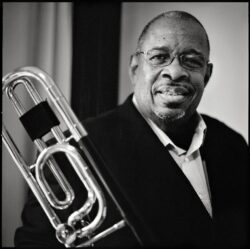
The composition’s untroubled spirit is an outlier for Generate Music, most of which is laced with unsettled or elegiac feelings. Longtime James Brown trombonist Fred Wesley’s “Requiem for AJ” serves as a bristling demonstration – a rollicking ode in memory of a friend who died young in an automobile accident. Rucker extends the memorial by paying homage to James Chaney, Michael Schwerner and Andrew Goodman, the three young men—one Black, two Jewish—murdered by the Ku Klux Klan while working as civil rights activists in Mississippi during the Freedom Summer of 1964.
The window-rattling finale of “Requiem for AJ” spotlights the pyrotechnic combustibility of Tyshawn Sorey’s drumming, surgically precise yet with a steamrolling power. The fluidity of Sorey’s rhythmic shifts throughout Generate Music is staggering, a reminder that this drummer and composer so enamored of extremes in his work is capable of the most exquisite subtlety. That pendulum swing is showcased by the Pulitzer winner’s untitled contribution. Achingly slow and discordant, the piece – a miniature of the epic-length sonic mystery of his three-album Pillars – exults in breath, stillness, harmonic depths and reverberation.
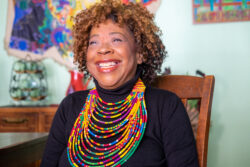
On “Let Us Gather & Go All Together, Can We?” Rucker revisits her most painful memory: the shooting and killing of her eldest brother, Ricardo Angelo Rucker, on Christmas Eve 1985 by a Jewish pharmacist. The story is one she’s reckoned with before. On “The Return to Innocence Lost,” the closing track of The Roots’ 1999 album Things Fall Apart, Rucker abstracted her brother, who struggled with addiction, into the character “First Son” for a fatalistic lament over the way that cycles of abuse and addiction can become self-fulfilling prophecies.
On “Let Us Gather & Go All Together, Can We?” Rucker revisits her most painful memory: the shooting and killing of her eldest brother” shifts the focus from her brother’s tragic story to its ongoing effect on Rucker’s own life, framing the shooting as a decisive moment in which she was forced to choose between anger and forgiveness. The improvised swell of music that accompanies the poem is a miasma of pain, rage, mourning and acceptance.
It’s followed by a Levy’s “Lament,” which offers a tender, palette-cleansing moment of catharsis. Originally written in 1986 as a saxophone quartet for his late father, the painter and printmaker Julian Levy, the work has been newly arranged by the composer with expanded instrumentation in response to Rucker’s piece. In Levy’s words, the pairing offers, “an act of empathy and compassion, to join Ursula in mourning the death of her beloved brother all these years later.”
The titular “Convergence” of Susan Watts’ composition arrives when the trumpeter and vocalist sings “Lift Every Voice and Sing,” often referred to as “the Black national anthem,” in Yiddish—translation as a form of empathy. Watts, who represents the fourth generation of a klezmer dynasty dating back to 19th-century Ukraine, depicts conflict through urgent, staccato unison blasts from the ensemble. That tense, unnerving foundation suddenly ceases for a stirring doina, a traditional improvised lament played over a drone, here provided by Rogers’ arco bass.
As a child, Diane Monroe attended a Baptist church at the same time that she accompanied her grandparents to the services of Black Jewish Rabbi Abel Respes at a synagogue in Philadelphia. She layers these two traditions together in “Ironies.” Watts intones melodies inspired by cantorial song accompanied by Krakauer’s klezmer-inspired clarinet, all subsumed within Sorey’s vigorous grooves. The saxophonists play snatches of the hymn “Sweet Hour of Prayer” and the Spiritual “Let Us Break Bread Together,” while Monroe’s violin traces the theme of another Spiritual, “Didn’t It Rain,” best known from Mahalia Jackson’s rendition. The two strains—from Jewish and Black liturgical repertoires—sometimes flow harmoniously into one another and at other moments grow fragmented, ultimately achieving a funky unity.
Composers Yotam Haber and Myra Melford both wrote pieces musing on the similarities and differences in the ways that the Black and Jewish communities interpret the word “Zion,” though their paths diverged during the compositional process. Haber’s starting point was his sense of a kinship in the fact that, for both communities, Zion “means going to a place of peace, a place of home.” His focus, and the shape of his piece, changed on October 7, 2023. Haber was in Jerusalem with his wife and children that morning, intending to spend the remainder of the year teaching there as a Fulbright Fellow. Instead, in the wake of the Hamas attacks he rushed his family home to Kansas City, Missouri, and wondered whether to even continue the work in the face of such staggering violence.
Thus, the “commotio cordis” that appears on Generate Music is, in Haber’s words, “a work of dissolution and disentanglement,” reflective of his disjoint experiences while composing it. The first half, penned prior to the attacks, makes stunning use of the PRISM saxophonists’ ability to blend their sounds to create shimmering, borealis-like hues as Rucker reads from the hymn “The Old Ship of Zion.” Sorey interrupts with a staggering, lurching rhythm to open the second half, the saxes growing discordant and piercing, the clarinet keening, hinting at uncertainty and even alarm.
Accompanied by text written and recited by the poet Erica Hunt, Melford’s “When the No Way Stops Short of the Somehow” ends the program on a stark and contemplative note. In Melford’s conception Zion is a utopian double-edged sword, a place that can instill hope and conjure division, a place of fantasy and memory, a place that lives deep inside the individual yet is a dangerously elusive fiction. The pointillism with which the piece begins slowly unites the ensemble into a propulsive cohesion, finally exploding into a climax that might be celebratory or might be bellicose, dissolving before we can know for sure.
It’s only fitting that Generate Music ends on such a note of uncertainty. The project nobly tackles questions for which there can be no definitive solution. Instead, this remarkable collection of music answers with hope, with solidarity, with comfort, with kinship, and with conscience.